
We went to a Physical Therapy meeting in a brewery.
We went to a Physical Therapy networking event in a brewery!
Monica helping spread the word about our upcoming class!
The memo on the office bulletin board peaked my interest. It highlighted a meeting organized by the GLAD district of Los Angeles for the CPTA. . The location was to be located in a brewery in Santa Clarita. See our photo diary below.
As anyone who reads this blog or follows Jetset Rehab Education on social media knows, we feel the networking is ESSENTIAL to clinicians.
By the way, this is why our classes are built around a great instructor AND a strong networking component built in.
Here are some reasons why networking is important for Clinicians:
- Referral system. Example: This particular night I met someone who is a Lymphadema specialist. I had been on the lookout for a specialist in this area for quite some time. Now I have someone I can send patients to if they need this service. These opportunities are everywhere! Perhaps your business or clinic provides a specialty service. After talking face to face you are more likely to get a referral vs. email ads and other forms of advertising. Think of this as word of mouth recommendations for your own business.
- New Friends. Like minded people are more likely to develop friendships due to common interests. Friendships are great for having emotional support and understanding. Think of your grad school friends. They were the only ones who understood the intensity of school work and your lifestyle. Just as important are the friends you meet in a profesional setting. More friends = always good.
Long lost friends
- Tips/Advice. "That mistake you are about to make, I've already made it."
Wouldn't it be nice to know Clinicians who have been through your path before? Who understand your struggles because their's are the same? Trust me, if you just look, you will find them.
If you need advice, friendship, or opportunity this is the place to be.
Paul, Hudson and Kristen PT, DPT, OCS. Little Ones first networking experience and first brewery.
Robin and Valerie
Special thanks to GLAD and the Wolfcreek Brewery for the great night!
Thanks for reading.
Check out our classes here.
Nancy Adachi on TMJ Controversy
Our instructor Nancy Adachi explains TMJ treatment and the controversies around it.
A New Interview!
We sat down with physical therapy specialist Nancy Adachi to dive into the evidence-based realities and clinical controversies surrounding Temporomandibular Joint Dysfunction (TMD).
Q: What is scalloping of the tongue and why is this significant for Rehab specialists?
Nancy Adachi: Scalloping indicates soft tissue changes on the tongue creating ridging marks along the sides of the tongue or front. Normally the tongue is smooth along the sides and rests on the the palate. If there are ridges, it may be caused by pushing the tongue against the teeth.
Q: What is the Occlusion Theory and what are your thoughts on this?
Who is often using this theory to treat and what is an example of a patient case where this theory was misused?
NA: Some dentists believe that the best treatment for TMD problems is a stable occlusion (bite). Thus braces or grinding the teeth or building up the teeth by crowns will alleviate the pain problems.
My belief as well as UCLA's is that the body tends to accommodate to imperfections and unless it is a gross or unstable or rapid change of the bite such as a car accident or injury to jaw and the bite is off, do not use non reversible methods to change the bite. An example PTs can use is leg shorter than another, we do not give everyone a heel lift. It would depend on the circumstances.
Q: What is bruxism and how do you address this?
What are some of the causes and consequences of bruxism?
NA: Bruxism is grinding or clenching of the teeth at night or during the day. We cannot control nighttime bruxism but during the day, we can give exercises and reminders of posture just like we do for low back pain or any other musculoskeletal pain problem.
Causes: are unknown but it is often exacerbated by stress and habit
Consequences for jaw pain patients: places extra load on the TMJ muscles and joints. The disc may be pushed more anteriorly causing potential pain, clicking and locking. Masseters, pytergoids, temporalis are on continuously rather than resting when not eating or opening, closing and swallowing.
Q: When do you recommend splints?
When have you seen the use of splints make the patient's TMD more severe?
NA: Usually hard acrylic full coverage splints are recommended for patients who have tried PT and exercises for myofascial pain and joint pain but still wake up in the AM with jaw pain. Also for the severe arthritic joints the splint can stabilize the bite and rest the jaw somewhat. Splints should not be worn 24-7 as it can change the bite permanently.
Splints that are not full coverage can cause teeth to erupt and bites to be anteriorly opened or closed.
Soft splints can cause pts to clench and grind more and usually disintegrate in a few months.
Q: There is talk among dentists on the internet that the next evolution of TMDs is the NTI brux splint. What are patients saying about this? What are your thoughts as a Physical Therapist on these?
NA: NTIs are similar to an anterior partial bite splint where the posterior teeth do not touch thus possibly decreasing clenching and grinding. The problems are that it can create a posterior open bite which would require reconstruction of the teeth and bite.
Indications are when a splint is needed ASAP as a stabilization splint takes 2 weeks to produce.
Q: What are some of the typical surgeries that you see in the jaw area?
NA: Arthroscopic surgery to release adhesions and clean the joint for anterior disc displacements that are non-reducible. Goal is to increase range of motion to functional range and symmetrical opening and ability to chew food and open.
Q: When have you seen the need to make money override the well being of the patient?
NA: Some surgeries and treatments that have no evidence based studies such as braces, total joint surgeries, using TENS to find the correct bite, cranio-sacral release.
Q: Where can you find a reputable dentist who treats TMDs without trying to sell them non indicated splints or who would be open to collaborating with Physical Therapists.
NA: Reputable dental schools such as UCLA or USC, they can refer you to community dentists that teach at the school, members of American Academy of Orofacial pain.
Words from a PT Jetsetter
Jetset Rehab Education Co Owner Randal Glaser interviews jetsetter Kristen Yanez on why she is going to Vegas to learn about TMJ.
"Who ever said learning can't be fun?"
- Kristen Yanez 2015
We like to ask our clients why they selected our company for their continuing education. In this case co owner Randal Glaser interviews PT Kristen Yanez.
RG: Glad you decided to sign up for this class! What made you choose Jetset Education's TMJ class?
KY: I signed up for the TMJ class for several reasons. I wanted a refresher course on TMJ dysfunction to brush up on treatment techniques and interventions. I have heard Nancy lecture on TMJ in the past, and found the material to be very useful and applicable to my current setting, so after hearing she was teaching the course I signed up. I am always looking for courses in different locations- and often try to make a little get away out of them. I feel the Jet Set rehab team has found the perfect way to combine- a great con-ed course in a fun location. Who ever said learning can't be fun?
RG: Which package did you choose?
KY: I choose the Vegas show package. I am currently 6.5 months pregnant and was pleased to see the different options available to fit the class participant's needs and interests. I also am a Beetles fan, so I am very excited to see "Love"- Mirage's Beatle themed cirque du soleil show.
RG: What about TMJ did you want to learn more about?
KY: I would like to learn about any new interventions or different ways to successfully manage and treat this population.
RG: What do you expect to gain clinically?
KY: I expect to gain clinically differential diagnosing strategies- to better understand and identify different TMJ dysfunctions. This will allow me to be more confident in choosing the best treatment option for my patient.
RG: Do you think this will help you gain access to a different patient population?
KY: I do think this will help access a different patient population. I feel this course will give me the tool to not only better identify TMJ dysfunction, but more successfully manage these patients. Collaboration with outside professions such as Dentists will be easier with knowing the language and standard measurements for the jaw.
RG: Congrats on your new baby to be! See you in Las Vegas!
KY: See you there!
Why sign up for a Jetset Rehab class? We asked a recent registrant.
Robin Pottukalam with his new Fitbit. He explains why he is taking a Jetset class.
Robin Pottukalam explains why he is taking a Jetset class. He is wearing his new Fitbit he won by registering for our next class on June 25-26th in Las Vegas.
The registrant we interviewed is our Fitbit Prize winner Robin Pottukalam PT, DPT, OCS. He currently works in California and is taking our next class on TMJ with Nancy Adachi in Las Vegas – June 25-26th. The following is an interview conducted with him over the phone. It has been edited for brevity.
Jetset Co-Owner Randal Glaser: First of all, on behalf of Jetset Rehab Education, congratulations on winning the Fitbit!
Robin Potukalum: I’m glad I won it!
RG: Now you are part of the Jetset family! What made you want to sign up for a Jetset class?:
RP: First of all, TMJ is a weakness of mine as far as an overall understanding of it. Secondly, I like the social aspect of the way the class is designed. In too many Con Ed classes people are out the door as soon as 5 o’clock hits. I don’t even get a chance to say goodbye or exchange numbers. This cycle repeats with every class I take.
RG: What made you realize that TMJ disorders where a weakness of yours?
RP: A couple of weeks ago I had a patient that I suspected had a TMJ issue and I was very lost. I had no idea what direction to go in. Up until now I have been sweeping it under the rug…saying to myself “how often does this come up?” but really how long can I get away with not being up to date on it [TMJ] and still feel proficient as a Therapist? This seemed like a good chance to learn more about it.
RG: It seems like you are really good at self-reflection, which is an important skill to have. What education have you had with TMJ thus far?
RP: I actually had Nancy Adachi lecture on TMJ in our PT school but it was very limited time wise. I didn’t get to see too much of it during my clinical affiliations either.
RG: Did our Fitbit giveaway convince you to sign up for the course?
RP: Well, I had already decided to sign up for it; I was just waiting for my paycheck to come in. As soon as I saw that offer though, I said, “why wait a couple of days? I might as well sign up now.” I already wanted to do it and had even made arrangements for my wife to meet me there. We are staying after the class is over to make a weekend out of it so I thought, “just go for it!” I can kill two birds with one stone, take a class then have a weekend with my wife on the same trip.
RG: What Jetset included package did you select when you registered for the course?
RP: I selected the entertainment Vegas show package. I have never been to a Vegas show and wanted to go to one with my wife. I never had the chance before.
RG: Are you getting reimbursed for taking this course?
RP: I am not. I am however using what my company calls “education days” where I can get paid my regular salary while I attend the class. So for me, this is a huge benefit because I am basically getting paid to take a class.
RG: You’re a professional student!
RP: yeah!
RG: Well once again, congrats on winning the prize and we can’t wait to meet you in Vegas!
RP: Thank you.
- you can join Robin and others in Las Vegas by taking our TMJ course on June 25-26th. (Hotel included until April 30th only)
look for updates on our podcast with Nancy to be released next week!
you can follow us on twitter @JetsetEducation
we are also on Facebook
you can follow Robin and his Physical Therapy adventures on twitter @RobinPottukalam
Jetsetting and Physical Therapy by Andre Chavez
Andre Chavez writes about how he combines Physical Therapy education and travel.
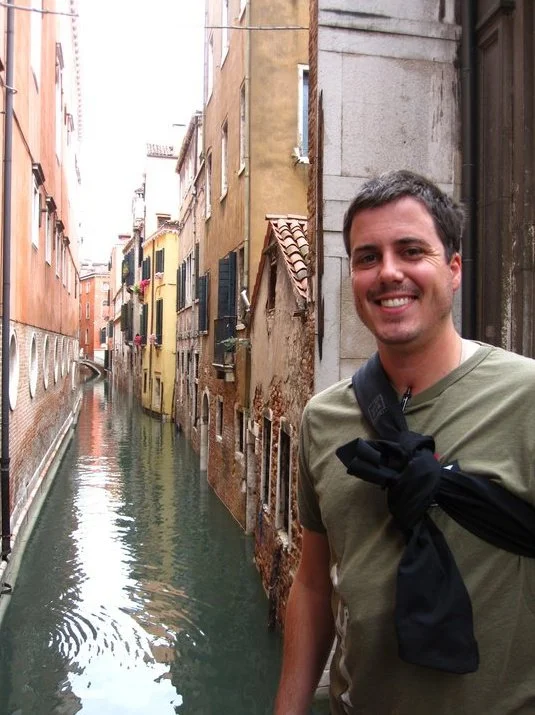
Andre Chavez in Venice, Italy
An article on gues-tblogger Andre Chavez
I love to learn but nothing will surpass my love to travel. I’ve been to courses all over the country: Boston, New Orleans, Denver, Nashville, San Diego, the list goes on and on . . . This is why I’m completely on board (pardon the pun) with Jetset Rehab Education. I have money set aside by my employer each year for continuing education courses and I get an excuse to travel along the way.
Last fall, I went to Prague for a weeklong course. Not only was it a stellar class, but I had the opportunity to rub elbows, dine, share drinks with, and get to know the instructors on a personal level. There were over 15 countries represented in the class. It was an eye opening experience to discover that physical therapists from around the world had the same questions and concerns as I did. It gave me a glimpse into their culture while giving my worldview a new perspective. Not to mention Prague is just fabulous on its own.
After the course was over, I decided to take side trips to Turkey and Hungary. Why not? I figured I might as well learn more about the eastern block countries. It ended up being a great cross-cultural experience, stuff you just can’t learn in a classroom.
I have also met amazing colleagues and lifelong friends by taking courses all over the states. When we catch up, we often reminisce about the one course where it all started. You can travel across the world, or just cross the state border, for a great course and a good time.
Go anywhere that you can get away from it all. Learn, network, let your hair down, and have some fun!
Whether you are learning to travel or traveling to learn, this is the opportunity for you.
Andre Chavez, DPT, OCS, friend of JetSetRehabEd.com and as of 2019, a member of the Jetset team.
Andre Chavez is a Physical Therapist currently working in Portland, Oregon.
You can follow his travels, Physical Therapy thoughts and ideas that often fall outside of the box on Twitter: @dre_rides_bikes
Please check out the Jetset classes here
5 Things rehab specialists need to know when treating TMJ pain.
Please check out our upcoming classes!
This photo is from a Doctor's note documenting their treatment plan for Temporal-Mandibular-Joint pain or TMJ pain. These are good general recommendations however most patients can find this type of treatment / advicewith a quick Google search. When they make an appointment with a rehab specialist, they are looking for more than just general recommendations.
They want to know: a) why they have the pain, and b) how to fix it.Soft tissue work, passive modalities and eating soft foods can get them started but will it fix the underlying factor that caused the pain?
TMJ pain is estimated to effect 22% of the population at one point in their lives. Despite its common occurrence, it is one of the conditions that get put into the background with pre professional education and thus is met with anxiety. But as Wayne Dyer said: “When you change the way you look at things, the things you look at change.” For me, this rings true for my journey learning to treat TMJ. The person who got me and countless others to change the way I look at things was Nancy Adachi. I took her weekend class in 2010 and still remember it and refer to my notes often.
Here are 5 things from Nancy Adachi's manuscript and class, that I feel everyone who treats TMJ should know.
Note: (I know, I know…there are more than 5 but if you want more information, you can read her 76 page manuscript or, I highly recommend taking one of her classes)
1. Treat the cervical spine:
Know how cervical posture relates to the TMJ. Lengthened deep neck flexors combined with upper cervical extension can increase TMJ compression and pull it out of centration. As the head sits with this forward head posture for prolonged time, the deep neck flexors can become lengthened leaving the jaw in a retruded position. This can lead to trigger points and abnormal wear and tear in the TMJ. Often we must treat the cause of this posture, which is often multifactorial: eyesight, lumbo-pelvic issues or ergonomics are common causes.
2. TMJ Disks, know when the disk is the issue and what treatment works best for this.
Disk displacement without reduction is usually an anterior and medial displacement, which makes the posterior part of the disk the weight-bearing surface. This can often lead to a clicking and if severe limited 25mm jaw opening. Those with clicking and full range of motion have early stage disk displacement, which is labeled “with reduction.“ Sometimes this will be accompanied with a lateral deviation. If translation of the TMJ is effected, manual therapy techniques can help here.
3. Don’t forget to rule out muscle coordination deficits.
If you place your fingers in front of your ear and then open your mouth, you may feel one side of your TMJ push into your thumb before the other. I can’t tell you how many times patients are able to abolish their pain by syncing both sides to move simultaneously. In this case the treatment would be coordinating opening and closing of the TMJ without clicking and simultaneous movement. No pain and no clicking indicate they are performing the movement correctly. Often this is the only home exercise they need.
4. Don’t forget about the emotional component.
These patients are really suffering. I mean how would you feel if you were unable to eat, yawn or talk without pain? TMJ is linked to fibromyalgia (some studies report 75% of this patient population) and can be linked to high anxiety behaviors such as jaw clenching or teeth grinding. For this reason I try to be especially understanding and reassuring when communicating with these patients. I also make sure to spend extra time educating them on the condition and the plan of care. Changing our language to reduce the threat of their TMJ pain is also a good idea.
5. Know when to partner with the Dentist, know how to communicate with them.
Many times if there are structural issues with the teeth, rehab prognosis will be limited. At times due to grinding at night and night guard may be indicated. This is when collaboration with a dentist may be needed.Here are some definitions I have found useful when communicating with dentists:
occlusion– the bringing of the opposing surfaces of the teeth into contact.
Anterior open bite– back teeth in contact while the front teeth aren’t touching.
Cross bite– one side of the mandible larger than the other.
Posterior open bite– a bite when the front teeth are touching while the back teeth aren’t.
Envelope of motion– a dental concept of extreme movement of the jaw in a sagittal plane.
This is just the tip of the iceberg as far as TMJ treatment considerations. There is much, much more to learn about the TMJ beyond the scope of a blog posting. If you are intrigued or need to, as Dyer says, “change the way you look at things” take a class from an expert such as Nancy Adachi.
I cannot recommend her class enough!
---------------------------------------------------------------------------------------------------------------
Update: The class was a great success.
below is a video from Nancy's class with Jetset Rehab Education.
Nancy Adachi on the right with fellow student JoAnne in our spring class.
Randal Glaser PT, DPT, OCS, CEAS I, is currently working as a Physical Therapist in California as well as organizing classes for Jetset Rehab Education. He is a published co-author in JOSPT and a graduate of the Kaiser Orthopedic residency and the Movement Science Fellowship.
Networking in Physical Therapy classes, a Fight Club perspective.
Networking in a Physical Therapywhat Fight Club taught me.
Networking is one the core values of the JetSet experience. It is a value that can enhance course understanding and expand a therapist’s understanding of their profession via interactions with fellow participants.
In the movie Fight Club, Edward Norton’s character, looked forward to his flights on an airplane. He realized of the countless hours spent on a trip, the most memorable involved networking with his “single serving friends” that sat next to him. His character (albeit twisted and cynical) goes on to meet a specific friend, Tyler Durden whom transforms his life forever. If you are physical therapist like me, you have a little bit of Ed Norton’s character in you. You have spent countless hours in school learning your craft and then additional hours in continuing education courses refining your skills. However, you realize that like his character, the journey is only part of the experience; the interactions with your colleagues are clearly as important.
Attending various continuing education courses over the years, I have realized that part of what made course experiences valuable was my interactions with colleagues. Attending a recent lecture on the DNS approach, I had questions about handholds that my classmates were able to critique and correct. Over the course of the one-day lecture, I found the interactions with my fellow colleagues bridged the gaps and made the class an even more meaningful experience. Additionally, networking with my colleagues during the course provided valuable clinical pearls that eventually lead to positive outcomes in the clinic.
Learning from my colleagues enriched my experience of the course content. However, networking during breaks and lunches also gaveme a better understanding of my profession. At a prior course, I learned how newly passed direct access law were affecting clinicians with regards to care and payment. In prior courses, I’ve even had the opportunity to meet international PTs whom discussed their practice in their respective countries For example, back pain patients check into the hospital for their symptoms in certain European countries & ACL patients can spend months rehabbing in the hospital in Japan!Having networked with my colleagues showed me how diverse our profession is internationally.
Networking has also illustrated how techniques can be utilized differently in specialties outside of orthopedics. In an MSIcourse I took a few years ago, I encountered therapists whom were utilizing the concepts learned on vestibular and neurologic patients.This brought to light how clinicians use“orthopedic” concepts in specialties not thought of as normally utilizing orthopedic skills.
Networking and interacting with many of my colleagues over the years has provided me with unique experiences that have enriched course content and broadened my understanding of our profession as a whole. In understanding the effect these experiences have had over the course of my career, I truly feel as lucky as Edward Norton’s character did on his plane when he met his friends. Looking back, if I had avoided these opportunities to network, my growth as a professional and a person surely would have been hindered. At your next class, remember to embrace your inner Edward Norton and reach out to your fellow colleagues. You may find that your class experience may be that much more beneficial.
Jay Bhatt is a Physical Therapist whom is an OCS and Published in JOSPT. He is one of the founders of JetSet Rehab Education.
Networking in Physical Therapy, what Fight Club taught me.
Networking is one the core values of the JetSet experience. It is a value that can enhance course understanding and expand a therapist’s understanding of their profession via interactions with fellow participants.
In the movie Fight Club, Edward Norton’s character, looked forward to his flights on an airplane. He realized of the countless hours spent on a trip, the most memorable involved networking with his “single serving friends” that sat next to him. His character (albeit twisted and cynical) goes on to meet a specific friend, Tyler Durden whom transforms his life forever. If you are physical therapist like me, you have a little bit of Ed Norton’s character in you. You have spent countless hours in school learning your craft and then additional hours in continuing education courses refining your skills. However, you realize that like his character, the journey is only part of the experience; the interactions with your colleagues are clearly as important.
Attending various continuing education courses over the years, I have realized that part of what made course experiences valuable was my interactions with colleagues. Attending a recent lecture on the DNS approach, I had questions about handholds that my classmates were able to critique and correct. Over the course of the one-day lecture, I found the interactions with my fellow colleagues bridged the gaps and made the class an even more meaningful experience. Additionally, networking with my colleagues during the course provided valuable clinical pearls that eventually lead to positive outcomes in the clinic.
Learning from my colleagues enriched my experience of the course content. However, networking during breaks and lunches also gaveme a better understanding of my profession. At a prior course, I learned how newly passed direct access law were affecting clinicians with regards to care and payment. In prior courses, I’ve even had the opportunity to meet international PTs whom discussed their practice in their respective countries For example, back pain patients check into the hospital for their symptoms in certain European countries & ACL patients can spend months rehabbing in the hospital in Japan! Having networked with my colleagues showed me how diverse our profession is internationally.
Networking has also illustrated how techniques can be utilized differently in specialties outside of orthopedics. In an MSIcourse I took a few years ago, I encountered therapists whom were utilizing the concepts learned on vestibular and neurologic patients.This brought to light how clinicians use“orthopedic” concepts in specialties not thought of as normally utilizing orthopedic skills.
Networking and interacting with many of my colleagues over the years has provided me with unique experiences that have enriched course content and broadened my understanding of our profession as a whole. In understanding the effect these experiences have had over the course of my career, I truly feel as lucky as Edward Norton’s character did on his plane when he met his friends. Looking back, if I had avoided these opportunities to network, my growth as a professional and a person surely would have been hindered. At your next class, remember to embrace your inner Edward Norton and reach out to your fellow colleagues. You may find that your class experience may be that much more beneficial.
Jay Bhatt is a Physical Therapist whom is an OCS and Published in JOSPT. He is one of the founders of JetSet Rehab Education.