
Physical Therapy CEU in Thailand: Phuket Course Gallery
“When you have fun the you’re more interested in learning”
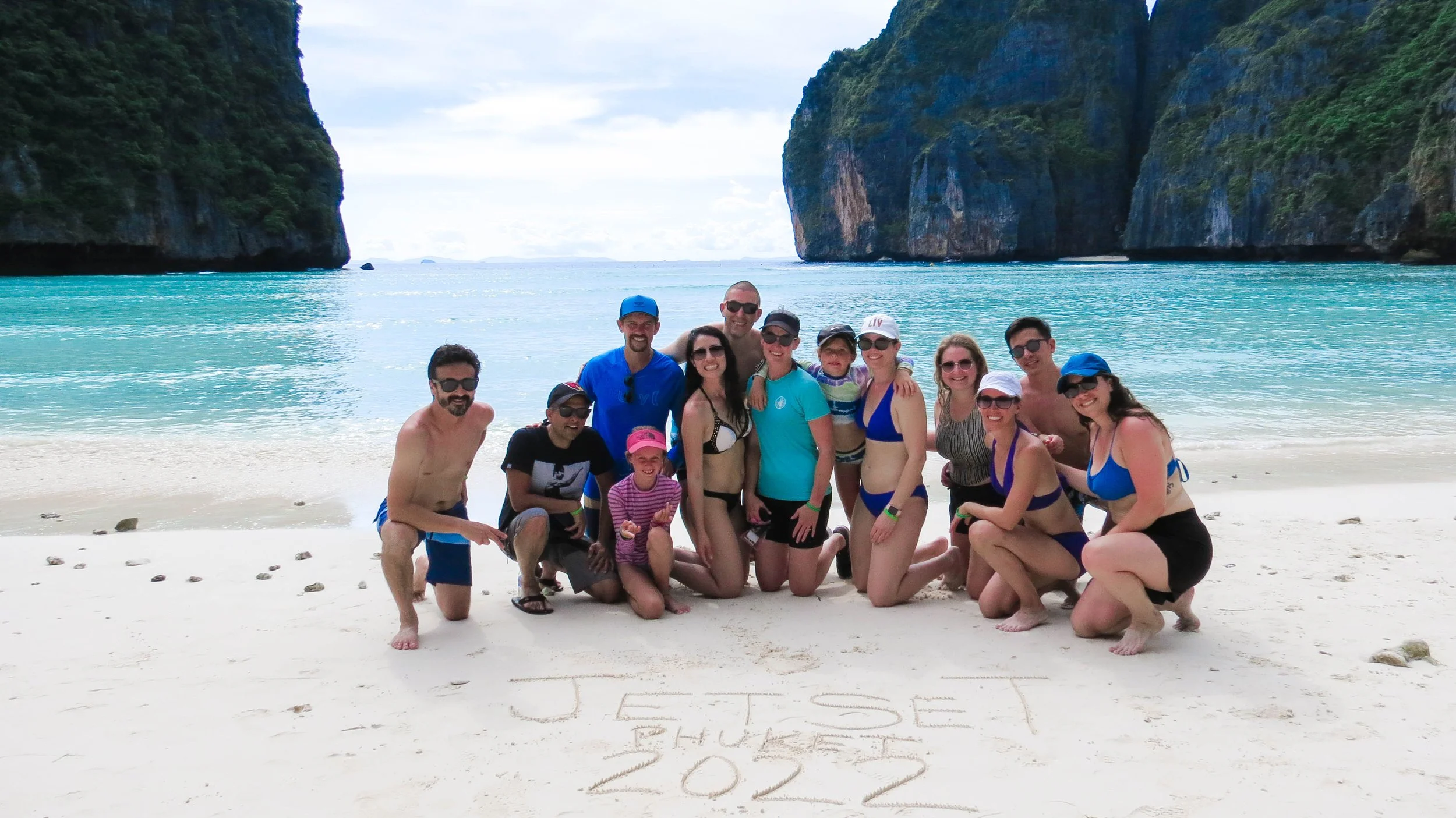
When writing about Thailand, I think I must start at the end. Maya Bay. First of all, it what many would say, the most beautiful spot in the world. There was a moment on the beach where we sat away from the crowd in the shade and admired the scene. At first we marveled at the beauty, how lucky we were to find such a nice spot in the shade away from the beating sun. Then we noted how our Jetset Travel crew was having an amazing time. They seemed to be, like us, awed by the natural beauty, enjoying being out in the open, joking with each other, there wasn’t a care in the world. We were all having this experience due to Clare Frank, (an instructor worth traveling accross the globe for) and our company, Jetset. It made us proud that our students along with Clare, trusted us to travel accross the globe and take part in this experience. This moment was a small victory for the Jetset team but although small, something about it felt like it was the most memorable. It was the culmination of 7 years of traveling with Jetset. Our first courses started in class rooms, then progressed to a Vegas Saloon, then an open air roof top beach hut in Cabo, to finally a hill side class classroom in Phuket.
We saw the Lemoine family (our students who brought their whole family) writing in the sand. We walked over and saw they had written “Jetset Phuket 2022.” I was taken aback at this gesture. Seeing this in the sand confirmed that we were indeed a part of their Thailand journey! It was such a kind gesture.
We took some photos and soon enough the ocean washed the writing away. It was a metaphor for this trip. Soon our memories would fade much like the writing in the sand. We will be left with a few souvenirs, our photos, and videos but most importantly friendships. I attempted to compile a photo journal for all who joined us and all who hope to join us in the future. We are now using this momentum to plan more courses and I hope you will be a part of joining our family in creating new memories, new clinical skills, solidifying old friendships, making new friendships, and having new experiences.
Hope to see you then,
The Jetset Team
““Life was meant for great adventures and close friends.””
Join us next year! courses available now!
Portland Michael Shacklock Photo Journal - Upper Quarter Neurodynamics
Find out what it is like to take a class with Jetset Rehab Education.
by Randal Glaser
First off, we would like to thank all of the amazing Portland rehab specialists who made it to the Michael Shacklock Upper Quarter Neurodynamics continuing education course. We had a good mix of Chiropractors, Physical Therapists, Athletic Trainers and other rehab specialists. We have had great respect for Michael Shacklock's book since our Physical Therapy school days and believe many who took the course share that same admiration. Not only did Michael exceed our expectations as an instructor, but he's a really good guy. We feel very lucky to have gotten to know him over beers and food.
The following are some photos we took that best capture the Jetset Rehab Education spirit and the way we organize a continuing education course. We are looking forward to build on the many friendships we made during our time in Portland.
The following photo diary is from the Upper Quarter class only. The Lower Quarter class photos will be shared next week. If you would like to request a specific image, please email us at JetsetRehabEd@gmail.com and we will reply with a raw copy of the selected photo(s).
Please note: later this month, all photos will be shared with students on a website and available to download to share on your blogs, websites, social properties and etc. At Jetset Rehab, we believe it's important to provide all assets that help our students' businesses thrive and succeed. Taking a continuing education course should allow for not only learning but networking. It is our hope that sharing videos and photos can assist with this.
If you haven't yet, please check out our Current Courses ! For feedback on the photo diary, please email jetsetrehabed@gmail.com or leave comments below.
5:30am Wake up and start to prep for the class. In an hour, we have to pick up Michael Shacklock and take him to Pacific University where it all begins.
We start the morning learning how tension on a contralateral nerve can take the tension off of a painful nerve. See the video below where Michael Shacklock (left) explains this concept.
Attentive students.
We are thankful to those who decided to attend the class. Nothing but positive energy.
Michael Shacklock demonstrates the palpation of the Median Nerve as students look on.
We can't stress this enough, limited class size allows students to get the most out of their experience. We take pride in knowing that everyone gets the opportunity to ask questions as well as one-on-one interactions with both the instructor and fellow classmates.
Michael Li (pictured here) is going to partner with Jetset Rehab Education for another continuing education class with Michael Shacklock on March 17, 2017. Follow us on social media for registration updates.
Michael Shacklock observes and palpates the Ulnar nerve. One can observe differences when comparing sides if one area has inflammation.
Lunch time! We cater many of our classes with high-quality food.
Later in the afternoon, we start the lab portion of the course. In this photo, every detail of the neurodynamic tests were reviewed piece by piece. In Photo - Allen Rubin.
Scot Morrison looks on with skepticism. Check out an old podcast we did with him HERE.
Joey Salgado, a Jetset Rehab Concorde club member and physical therapy continuing education student, came all the way up from the Bay Area where he runs his Private Practice clinic: Progressive Motion Physical Therapy.
Andre "The Great" Chavez with Michael Shacklock.
Andre teaches for Movement Links and helps Jetset Rehab Education organize continuing education courses for Chiropractors, Athletic Trainers and Physical Therapists. He and the Jetset Rehab team collaborated on a case study which was published in JOSPT.
Handhold details are stressed in this course. Median Nerve test pictured.
Follow Michael Shacklock on RESEARCHGATE (the Facebook of research as he says)
A small class size is very important! It's ok to ask organizers how many students will be in the classroom. If the class size is too large, this moment is not going to happen.
Joey Salgado demonstrates the Radial Nerve test. The differentiation is at the scapula which he is stabilizing at the hip.
Lab discussion.
Michael Shacklock speaks as Scot Morrison and Phillip Snell look on.
We are very big on networking after class, hence the hashtag #stayafterclass.
We met up at a brewery with the instructor so our students could discuss the class, life, business, sports or anything else over some great food and beer.
Wouldn't you rather leave the classroom and discuss Neurodynamics here?
DAY 2: Phillip Snell and Scot Morrison with Michael Shacklock.
Day 2: in class discussion.
Justin Dean and friends. Justin is doing some great work with Rehab 2 Performance (R2P ISCRS). Stay tuned for an upcoming podcast with Justin and Phillip Snell.
We would like to thank Ecliptic Brewing for the great service and amazing food and drink. The space was amazing. A great time networking and meeting new friends.
Nice of Katherine Finn @ktptdpt to stop by. She attended our Las Vegas course but we love to invite former students to our networking events when we are in their town.
Left to right: Josh Moreali PT,SFMA, RKC , Joey Salgado DPT, SFMA, TPI, and Michael Shacklock (telling jokes)
Justin Dean in the Ecliptic Brewery.
Brewery scene. All food and drinks were included as part of our networking experience in this class by the way.
As a continuing education company for Rehab Specialists, Physical Therapists, Chiropractors, Athletic Trainers, Occupational Therapists, Jetset Rehab Education is based on 3 main things:
1. Great Instructors
2. Small Classroom
3. Networking events built in to the course
If this sounds like something you'd be into, Please follow us on social media and tell a friend.
Subscribe to our podcast and check out our next class!
Thank You Jetsetters!!!!!!!!!!!!
Please follow us above and stay tuned for our podcast with Michael Shacklock next week.
Randal Glaser PT, DPT, OCS, CEAS I is a co-founder of Jetset Rehab Education as well as the Clinical Specialist for the Santa Clarita Kaiser Permanente Physical Therapy Clinic. Founder of Harmin Ergonomics. He is also a freelance photographer and former film student as well.
Why sign up for a Jetset Rehab class? We asked a recent registrant.
Robin Pottukalam with his new Fitbit. He explains why he is taking a Jetset class.
Robin Pottukalam explains why he is taking a Jetset class. He is wearing his new Fitbit he won by registering for our next class on June 25-26th in Las Vegas.
The registrant we interviewed is our Fitbit Prize winner Robin Pottukalam PT, DPT, OCS. He currently works in California and is taking our next class on TMJ with Nancy Adachi in Las Vegas – June 25-26th. The following is an interview conducted with him over the phone. It has been edited for brevity.
Jetset Co-Owner Randal Glaser: First of all, on behalf of Jetset Rehab Education, congratulations on winning the Fitbit!
Robin Potukalum: I’m glad I won it!
RG: Now you are part of the Jetset family! What made you want to sign up for a Jetset class?:
RP: First of all, TMJ is a weakness of mine as far as an overall understanding of it. Secondly, I like the social aspect of the way the class is designed. In too many Con Ed classes people are out the door as soon as 5 o’clock hits. I don’t even get a chance to say goodbye or exchange numbers. This cycle repeats with every class I take.
RG: What made you realize that TMJ disorders where a weakness of yours?
RP: A couple of weeks ago I had a patient that I suspected had a TMJ issue and I was very lost. I had no idea what direction to go in. Up until now I have been sweeping it under the rug…saying to myself “how often does this come up?” but really how long can I get away with not being up to date on it [TMJ] and still feel proficient as a Therapist? This seemed like a good chance to learn more about it.
RG: It seems like you are really good at self-reflection, which is an important skill to have. What education have you had with TMJ thus far?
RP: I actually had Nancy Adachi lecture on TMJ in our PT school but it was very limited time wise. I didn’t get to see too much of it during my clinical affiliations either.
RG: Did our Fitbit giveaway convince you to sign up for the course?
RP: Well, I had already decided to sign up for it; I was just waiting for my paycheck to come in. As soon as I saw that offer though, I said, “why wait a couple of days? I might as well sign up now.” I already wanted to do it and had even made arrangements for my wife to meet me there. We are staying after the class is over to make a weekend out of it so I thought, “just go for it!” I can kill two birds with one stone, take a class then have a weekend with my wife on the same trip.
RG: What Jetset included package did you select when you registered for the course?
RP: I selected the entertainment Vegas show package. I have never been to a Vegas show and wanted to go to one with my wife. I never had the chance before.
RG: Are you getting reimbursed for taking this course?
RP: I am not. I am however using what my company calls “education days” where I can get paid my regular salary while I attend the class. So for me, this is a huge benefit because I am basically getting paid to take a class.
RG: You’re a professional student!
RP: yeah!
RG: Well once again, congrats on winning the prize and we can’t wait to meet you in Vegas!
RP: Thank you.
- you can join Robin and others in Las Vegas by taking our TMJ course on June 25-26th. (Hotel included until April 30th only)
look for updates on our podcast with Nancy to be released next week!
you can follow us on twitter @JetsetEducation
we are also on Facebook
you can follow Robin and his Physical Therapy adventures on twitter @RobinPottukalam
5 Things rehab specialists need to know when treating TMJ pain.
Please check out our upcoming classes!
This photo is from a Doctor's note documenting their treatment plan for Temporal-Mandibular-Joint pain or TMJ pain. These are good general recommendations however most patients can find this type of treatment / advicewith a quick Google search. When they make an appointment with a rehab specialist, they are looking for more than just general recommendations.
They want to know: a) why they have the pain, and b) how to fix it.Soft tissue work, passive modalities and eating soft foods can get them started but will it fix the underlying factor that caused the pain?
TMJ pain is estimated to effect 22% of the population at one point in their lives. Despite its common occurrence, it is one of the conditions that get put into the background with pre professional education and thus is met with anxiety. But as Wayne Dyer said: “When you change the way you look at things, the things you look at change.” For me, this rings true for my journey learning to treat TMJ. The person who got me and countless others to change the way I look at things was Nancy Adachi. I took her weekend class in 2010 and still remember it and refer to my notes often.
Here are 5 things from Nancy Adachi's manuscript and class, that I feel everyone who treats TMJ should know.
Note: (I know, I know…there are more than 5 but if you want more information, you can read her 76 page manuscript or, I highly recommend taking one of her classes)
1. Treat the cervical spine:
Know how cervical posture relates to the TMJ. Lengthened deep neck flexors combined with upper cervical extension can increase TMJ compression and pull it out of centration. As the head sits with this forward head posture for prolonged time, the deep neck flexors can become lengthened leaving the jaw in a retruded position. This can lead to trigger points and abnormal wear and tear in the TMJ. Often we must treat the cause of this posture, which is often multifactorial: eyesight, lumbo-pelvic issues or ergonomics are common causes.
2. TMJ Disks, know when the disk is the issue and what treatment works best for this.
Disk displacement without reduction is usually an anterior and medial displacement, which makes the posterior part of the disk the weight-bearing surface. This can often lead to a clicking and if severe limited 25mm jaw opening. Those with clicking and full range of motion have early stage disk displacement, which is labeled “with reduction.“ Sometimes this will be accompanied with a lateral deviation. If translation of the TMJ is effected, manual therapy techniques can help here.
3. Don’t forget to rule out muscle coordination deficits.
If you place your fingers in front of your ear and then open your mouth, you may feel one side of your TMJ push into your thumb before the other. I can’t tell you how many times patients are able to abolish their pain by syncing both sides to move simultaneously. In this case the treatment would be coordinating opening and closing of the TMJ without clicking and simultaneous movement. No pain and no clicking indicate they are performing the movement correctly. Often this is the only home exercise they need.
4. Don’t forget about the emotional component.
These patients are really suffering. I mean how would you feel if you were unable to eat, yawn or talk without pain? TMJ is linked to fibromyalgia (some studies report 75% of this patient population) and can be linked to high anxiety behaviors such as jaw clenching or teeth grinding. For this reason I try to be especially understanding and reassuring when communicating with these patients. I also make sure to spend extra time educating them on the condition and the plan of care. Changing our language to reduce the threat of their TMJ pain is also a good idea.
5. Know when to partner with the Dentist, know how to communicate with them.
Many times if there are structural issues with the teeth, rehab prognosis will be limited. At times due to grinding at night and night guard may be indicated. This is when collaboration with a dentist may be needed.Here are some definitions I have found useful when communicating with dentists:
occlusion– the bringing of the opposing surfaces of the teeth into contact.
Anterior open bite– back teeth in contact while the front teeth aren’t touching.
Cross bite– one side of the mandible larger than the other.
Posterior open bite– a bite when the front teeth are touching while the back teeth aren’t.
Envelope of motion– a dental concept of extreme movement of the jaw in a sagittal plane.
This is just the tip of the iceberg as far as TMJ treatment considerations. There is much, much more to learn about the TMJ beyond the scope of a blog posting. If you are intrigued or need to, as Dyer says, “change the way you look at things” take a class from an expert such as Nancy Adachi.
I cannot recommend her class enough!
---------------------------------------------------------------------------------------------------------------
Update: The class was a great success.
below is a video from Nancy's class with Jetset Rehab Education.
Nancy Adachi on the right with fellow student JoAnne in our spring class.
Randal Glaser PT, DPT, OCS, CEAS I, is currently working as a Physical Therapist in California as well as organizing classes for Jetset Rehab Education. He is a published co-author in JOSPT and a graduate of the Kaiser Orthopedic residency and the Movement Science Fellowship.
Networking in Physical Therapy classes, a Fight Club perspective.
Networking in a Physical Therapywhat Fight Club taught me.
Networking is one the core values of the JetSet experience. It is a value that can enhance course understanding and expand a therapist’s understanding of their profession via interactions with fellow participants.
In the movie Fight Club, Edward Norton’s character, looked forward to his flights on an airplane. He realized of the countless hours spent on a trip, the most memorable involved networking with his “single serving friends” that sat next to him. His character (albeit twisted and cynical) goes on to meet a specific friend, Tyler Durden whom transforms his life forever. If you are physical therapist like me, you have a little bit of Ed Norton’s character in you. You have spent countless hours in school learning your craft and then additional hours in continuing education courses refining your skills. However, you realize that like his character, the journey is only part of the experience; the interactions with your colleagues are clearly as important.
Attending various continuing education courses over the years, I have realized that part of what made course experiences valuable was my interactions with colleagues. Attending a recent lecture on the DNS approach, I had questions about handholds that my classmates were able to critique and correct. Over the course of the one-day lecture, I found the interactions with my fellow colleagues bridged the gaps and made the class an even more meaningful experience. Additionally, networking with my colleagues during the course provided valuable clinical pearls that eventually lead to positive outcomes in the clinic.
Learning from my colleagues enriched my experience of the course content. However, networking during breaks and lunches also gaveme a better understanding of my profession. At a prior course, I learned how newly passed direct access law were affecting clinicians with regards to care and payment. In prior courses, I’ve even had the opportunity to meet international PTs whom discussed their practice in their respective countries For example, back pain patients check into the hospital for their symptoms in certain European countries & ACL patients can spend months rehabbing in the hospital in Japan!Having networked with my colleagues showed me how diverse our profession is internationally.
Networking has also illustrated how techniques can be utilized differently in specialties outside of orthopedics. In an MSIcourse I took a few years ago, I encountered therapists whom were utilizing the concepts learned on vestibular and neurologic patients.This brought to light how clinicians use“orthopedic” concepts in specialties not thought of as normally utilizing orthopedic skills.
Networking and interacting with many of my colleagues over the years has provided me with unique experiences that have enriched course content and broadened my understanding of our profession as a whole. In understanding the effect these experiences have had over the course of my career, I truly feel as lucky as Edward Norton’s character did on his plane when he met his friends. Looking back, if I had avoided these opportunities to network, my growth as a professional and a person surely would have been hindered. At your next class, remember to embrace your inner Edward Norton and reach out to your fellow colleagues. You may find that your class experience may be that much more beneficial.
Jay Bhatt is a Physical Therapist whom is an OCS and Published in JOSPT. He is one of the founders of JetSet Rehab Education.
Networking in Physical Therapy, what Fight Club taught me.
Networking is one the core values of the JetSet experience. It is a value that can enhance course understanding and expand a therapist’s understanding of their profession via interactions with fellow participants.
In the movie Fight Club, Edward Norton’s character, looked forward to his flights on an airplane. He realized of the countless hours spent on a trip, the most memorable involved networking with his “single serving friends” that sat next to him. His character (albeit twisted and cynical) goes on to meet a specific friend, Tyler Durden whom transforms his life forever. If you are physical therapist like me, you have a little bit of Ed Norton’s character in you. You have spent countless hours in school learning your craft and then additional hours in continuing education courses refining your skills. However, you realize that like his character, the journey is only part of the experience; the interactions with your colleagues are clearly as important.
Attending various continuing education courses over the years, I have realized that part of what made course experiences valuable was my interactions with colleagues. Attending a recent lecture on the DNS approach, I had questions about handholds that my classmates were able to critique and correct. Over the course of the one-day lecture, I found the interactions with my fellow colleagues bridged the gaps and made the class an even more meaningful experience. Additionally, networking with my colleagues during the course provided valuable clinical pearls that eventually lead to positive outcomes in the clinic.
Learning from my colleagues enriched my experience of the course content. However, networking during breaks and lunches also gaveme a better understanding of my profession. At a prior course, I learned how newly passed direct access law were affecting clinicians with regards to care and payment. In prior courses, I’ve even had the opportunity to meet international PTs whom discussed their practice in their respective countries For example, back pain patients check into the hospital for their symptoms in certain European countries & ACL patients can spend months rehabbing in the hospital in Japan! Having networked with my colleagues showed me how diverse our profession is internationally.
Networking has also illustrated how techniques can be utilized differently in specialties outside of orthopedics. In an MSIcourse I took a few years ago, I encountered therapists whom were utilizing the concepts learned on vestibular and neurologic patients.This brought to light how clinicians use“orthopedic” concepts in specialties not thought of as normally utilizing orthopedic skills.
Networking and interacting with many of my colleagues over the years has provided me with unique experiences that have enriched course content and broadened my understanding of our profession as a whole. In understanding the effect these experiences have had over the course of my career, I truly feel as lucky as Edward Norton’s character did on his plane when he met his friends. Looking back, if I had avoided these opportunities to network, my growth as a professional and a person surely would have been hindered. At your next class, remember to embrace your inner Edward Norton and reach out to your fellow colleagues. You may find that your class experience may be that much more beneficial.
Jay Bhatt is a Physical Therapist whom is an OCS and Published in JOSPT. He is one of the founders of JetSet Rehab Education.
How We Learn Best
How should Physical Therapists learn? It may not be a classroom setting.
I am a Physical Therapist in a primary care setting. I work next to and co-treat patients with Doctors throughout the day. Because of
this, I am able to see a lot of the differences in how we have been educated, how we think, and how we clinically reason. This difference has
extended to how continuing classes have been designed.
As I was talking with one of my Dr. colleagues he mentioned that he was going on a cruise to the Bahamas with his family. He was
taking a continuing education course and was planning on getting out of class early to enjoy the sun, family time and simply not being
in his office. “I bet there won’t be a lot of learning over there, right?” I quipped. “Actually, I went last year and I learned a lot!” “I still
remember a lot from those classes, something about short classes and having more time to discuss with my classmates afterwards just
helped it stick.” He explained.
This I found, is not only a common theme in Doctor classes but across our lives as well. If I think back to lessons I learned both in rehab and
out of it, I can point to many instances where the “a-ha” moment was achieved outside of the classroom. This is backed by other
reports as well. In a Rasmussen poll 81% of respondents reported learning more outside of the classroom than in the classroom.
According to Paul Hudson, writer for Elite Daily, the classroom/school setting is set up for short term goals: semesters, grades, report
cards. Life doesn’t always work this way. His article further explains that In real life networking and long-term goals are most often
what helps someone progress professionally.
There are countless examples of people who suffer great pains to learn Algebra in school only to thrive when asked to do the same
problem as it applies to their job. Examples include a chef who has to triple a recipe or a carpenter asked to calculate area, volume,
and circumference when building cabinets. As a Physical Therapist, my key moments came with mentorship in the clinic, not the
classroom. In addition, most PTs will tell you that they have learned far more after they graduated as a clinician, than from school.
I don’t want to conclude that the classroom is a bad way to learn, in fact, I do not see any other way to teach valuable information to a
large amount of people. What I do see however is that we have fallen into a rut as far as teaching in most continuing education
classes. My question: Is there a better way? Can we make information “stick” if we change the environment? Is the Doctor’s class in
the Bahama cruise onto something?
Many other professions have already started vacation / education classes. The reason for this seems to be more complex than improving attendance. There is
the additional benefits that come with travel. These lead to networking opportunities and participation in activities after the class. These
lead to professional connections, more access to instructors, and even friendships. Consider this quote from the U.S. Ambassador for
the Asia-Pacific Economic Cooperation on why he held his most notable meetings at a vacation spot in Hawaii, “When people are
relaxed, they think more clearly, and when they think more clearly, they’re more likely to come to conclusions that result in
agreements.”
I may be biased but I can’t think of a profession that could benefit more from this than Physical Therapists.
Randal Glaser PT, DPT, OCS is a Physical Therapist in California and is currently working on developing continuing education courses for
JetSetRehabEd.com.
It may not be a classroom setting.
I am a Physical Therapist in a primary care setting. I work next to and co-treat patients with Doctors throughout the day. Because of this, I am able to see a lot of the differences in how our professions have been educated, how we think, and how we clinically reason. This difference has extended to how continuing classes have been designed.
As I was talking with one of my Dr. colleagues he mentioned that he was going on a cruise to the Bahamas with his family. He was taking a continuing education course and was planning on getting out of class early to enjoy the sun, family time and simply not being in his office. “I bet there won’t be a lot of learning over there, right?” I quipped. “Actually, I went last year and I learned a lot!” “I still remember a lot from those classes, something about short classes and having more time to discuss with my classmates afterwards just helped it stick.” He explained.
This I found is not only a common theme with Doctors, but across our lives as well. If I think back to lessons I learned both in rehab and in life, I can point to many instances where the “a-ha” moment was achieved outside of the classroom. This is backed by other reports as well. In a Rasmussen poll 81% of respondents reported learning more outside of the classroom than in the classroom. According to Paul Hudson, writer for Elite Daily, the classroom/school setting is set up for short-term goals: semesters, grades, and report cards. Life doesn’t always work this way. His article further explains that In real life, networking and long-term goals are most often what helps someone progress within their profession.
There are countless examples of people who suffer great pains to learn Algebra in school only to thrive when asked to do the same problem as it applies to their job. Examples include a chef who has to triple a recipe or a carpenter asked to calculate area, volume, and circumference when building cabinets. As a Physical Therapist, my key moments came with mentorship in the clinic, not the classroom. In addition, most PTs will tell you that they have learned far more after they graduated as a clinician, than from school.
I don’t want to conclude that the classroom is a bad way to learn, in fact, I do not see any other way to teach valuable information to a large amount of people. However, what I do see is that we have fallen into a teaching rut in most continuing education classes. My question: Is there a better way? Can we make information “stick” if we change the environment? Is the Doctor’s class in the Bahamas onto something?
Many other professions have already started this. The reason seems to be more complex than improving attendance. There are the additional benefits that come with travel. These lead to networking opportunities and participation in activities after the class. These often lead to professional connections, more access to instructors, and even friendships. Consider this quote from the U.S. Ambassador for the Asia-Pacific Economic Cooperation on why he held his most notable meetings at a vacation spot in Hawaii, “When people are relaxed, they think more clearly, and when they think more clearly, they’re more likely to come to conclusions that result in agreements.”
I may be biased, but I can’t think of people who could benefit more from this than Physical Therapists.
Randal Glaser PT, DPT, OCS is a Physical Therapist in California and is currently working on developing continuing education courses for JetSetRehabEd.com.