
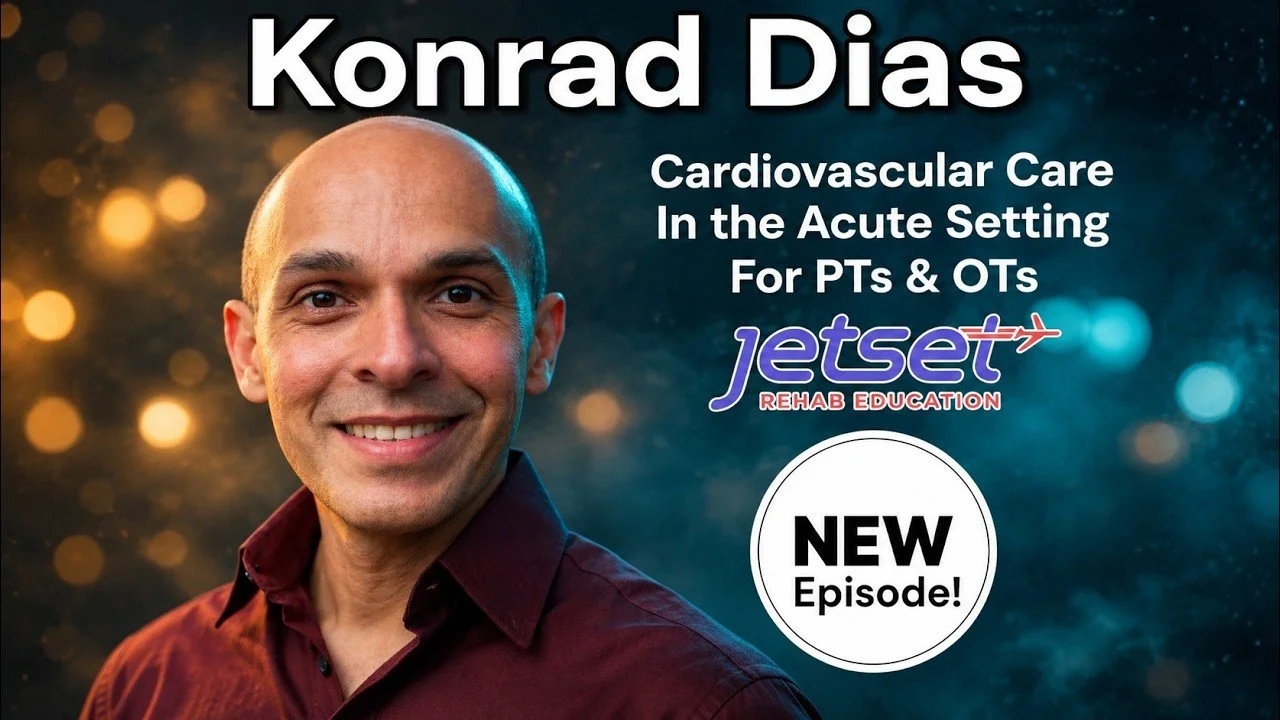
Connecting the Evidence to the Bedside
Acute care therapists don't have time to read randomized controlled trials between patients. Dr. Konrad Dias has spent much of his 23-year teaching career closing that gap. On the latest episode of the Jetset Physical Therapy Podcast, Randall and Jay sat down with Dr. Dias, Professor Emeritus at Sacramento State, ahead of his Cabo San Lucas course this spring, to talk cardiovascular and pulmonary care for PTs and OTs across acute care, home health, and outpatient settings.
Dr. Dias describes most of his research as the "scholarship of application": less about discovering new knowledge and more about helping clinicians use what's already known. That includes his work on cardiopulmonary clinical practice guidelines and a series of knowledge translation papers. His courses are built the same way. The goal isn't to cover everything. It's to help you pick two or three things you'll actually change on Monday morning.
The Two Biggest Challenges in Acute Care Right Now
When Randall asked what he hears most from clinicians in his courses, Dr. Dias named two things:
Time and productivity. Seeing eight to ten patients a day plus documentation makes it hard to bring new knowledge to the bedside. His answer is to make small, achievable changes and build on them over time.
Showing our value. PTs have a real opportunity to demonstrate clinical autonomy to physicians, nurses, and the rest of the interprofessional team, and to do things that make them say, "I didn't know PTs did that."
"It's Not Just Walking the Patient in the Hallway"
What separates a confident acute care clinician from a newer one? Dr. Dias pointed to being open to change and, above all, reflection: stepping back after a session and asking whether you did the best you could for that patient, or just the routine.
He pushes clinicians to ask why they're choosing each intervention. What is it doing at the level of the heart? At the level of the muscle? For this person's activity and participation? Getting someone out of bed is a means, not the goal.
Why Outpatient and Home Health PTs Belong in This Room
Randall asked the question a lot of outpatient clinicians are probably wondering: is this course for me? Dr. Dias's answer was an emphatic yes. (He also joked that he'd be terrified at an orthopedic course.)
His reasoning: patients don't stop having heart failure when they leave the hospital. A few days after discharge, that same person may show up in an outpatient clinic for a total knee. If you don't understand their ejection fraction or cardiac stability, you can overdose the exercise and push them toward decompensation. That's why the course opens with a quick review of physiology and terminology. Once you understand why something presents the way it does, you're much more likely to use it.
He also highlighted readmissions. In his words, close to one in four patients with heart failure go back to the hospital within 30 days of discharge. Home health and outpatient PTs who monitor stability visit to visit can catch changes early, communicate with the team, and potentially keep that patient out of the ambulance.
Chest Pain and EKGs Across the Continuum of Care
Two practical skills came up repeatedly: a formal approach to differentially diagnosing chest pain (cardiac versus pulmonary), and EKG literacy.
On EKGs, Dr. Dias pointed out that atrial fibrillation is no longer just an acute care problem. Smartwatches and phones are picking up arrhythmias everywhere, and patients are bringing those readings to every setting. He frames cardiac problems in three buckets:
Mechanical (the muscle itself is damaged or ischemic)
Valvular
Electrical
When a patient is short of breath and fatigued, which describes nearly everyone in the cardiopulmonary world, the EKG helps you figure out whether an electrical problem is part of the picture. But he was clear that dosing doesn't follow a bucket-by-bucket recipe. It comes from a holistic exam of the patient's stability at that visit, which then tells you whether to go up a notch or back off.
Asking the "Why" Question
Randall asked for an example of a clinical miss the course could prevent. Dr. Dias flipped it into something more useful: the opportunity clinicians miss when they don't ask why a patient has a condition in the first place.
Why did this patient have a heart attack? Why do they have atrial fibrillation? Asking that question moves you from functional mobility alone into prevention and education. He pointed to research, including a paper he authored, suggesting that meaningful weight loss in patients with obesity and AFib can substantially reduce or even reverse the arrhythmia, sometimes alongside or instead of ablation. That's the kind of impact he wants clinicians to see as part of their role.
Where AI Fits
Like several recent guests, Dr. Dias sees AI as a starting point rather than an answer. It can summarize research or give you an early read on a clinical question, but you still need to go back to the articles, check for bias, and apply your own reasoning. His rule: AI has to be complementary, never exclusive. (If you want a walkthrough, check out Jay's episode on using OpenEvidence to synthesize the literature.)
Join Dr. Dias in Cabo, April 24–25, 2027
Dr. Dias is teaching his acute care and cardiopulmonary course for Jetset in Cabo San Lucas on April 24–25, 2027. It's built for acute care therapists, and just as much for outpatient, home health, PT, and OT clinicians who see patients with cardiac and pulmonary conditions. Hotel nights at the Bahia Hotel near Medano Beach, breakfast, and lunch are included, plus a networking happy hour after day one.
Reserve your seat in Cabo and catch the full conversation on the Jetset Physical Therapy Podcast.