
BPPV Isn't Complicated, You're Just Asking the Wrong Questions
Vestibular Rehab Tips from Two Vestibular-Certified PTs
Every physical therapist has had this moment: a patient lies down on the table and says, "I'm dizzy." You wait for it to pass, maybe ask if they're okay, and then continue the session. But what if that thirty-second moment is actually the most important part of the visit?
On the latest episode of the Jetset Physical Therapy Podcast, hosts Randall and Jay sat down with Kendra Harring DPT, GCS and Brittany Valdez DPT, NCS, two vestibular-certified physical therapists and the instructors behind Jetset's upcoming continuing education course in Hawaii, to talk about how to actually screen and treat dizzy patients, including the ones who never even get sent to a vestibular specialist.
The Questions That Actually Matter
Kendra and Brittany's approach starts with two deceptively simple questions: "When are you dizzy?" and "Without using the word 'dizzy,' how would you describe what you're feeling?"
That second question does a lot of work. Patients often use "dizzy" as a catch-all for lightheadedness, spinning, imbalance, or general unease, and each of those points somewhere different. As Brittany put it, the goal is to cut through the fluff and "get the answer, and just listen to the actual answer instead of all the fluff that's around it."
For suspected BPPV specifically, duration is the tell. Constant dizziness points one direction; brief spinning episodes lasting seconds and triggered by position changes point straight at benign paroxysmal positional vertigo.
When the Dix-Hallpike Doesn't Cooperate
Here's a scenario every PT has run into: the patient's history says textbook BPPV, but the Dix-Hallpike test comes back negative. Now what?
Kendra and Brittany's answer surprised even the hosts: you don't necessarily need visible nystagmus to call it BPPV. Some patients, especially those who've had symptoms long enough, learn to suppress the eye movement. Instead, the clinicians look for a crescendo and decrescendo of reported symptoms, "there it is, there it is... it's going away, it's going away" even when the eyes stay still. That pattern, combined with the patient's history, is often enough to justify treating with an Epley maneuver and reassessing.
Epley, Gufoni, or Barbecue Roll?
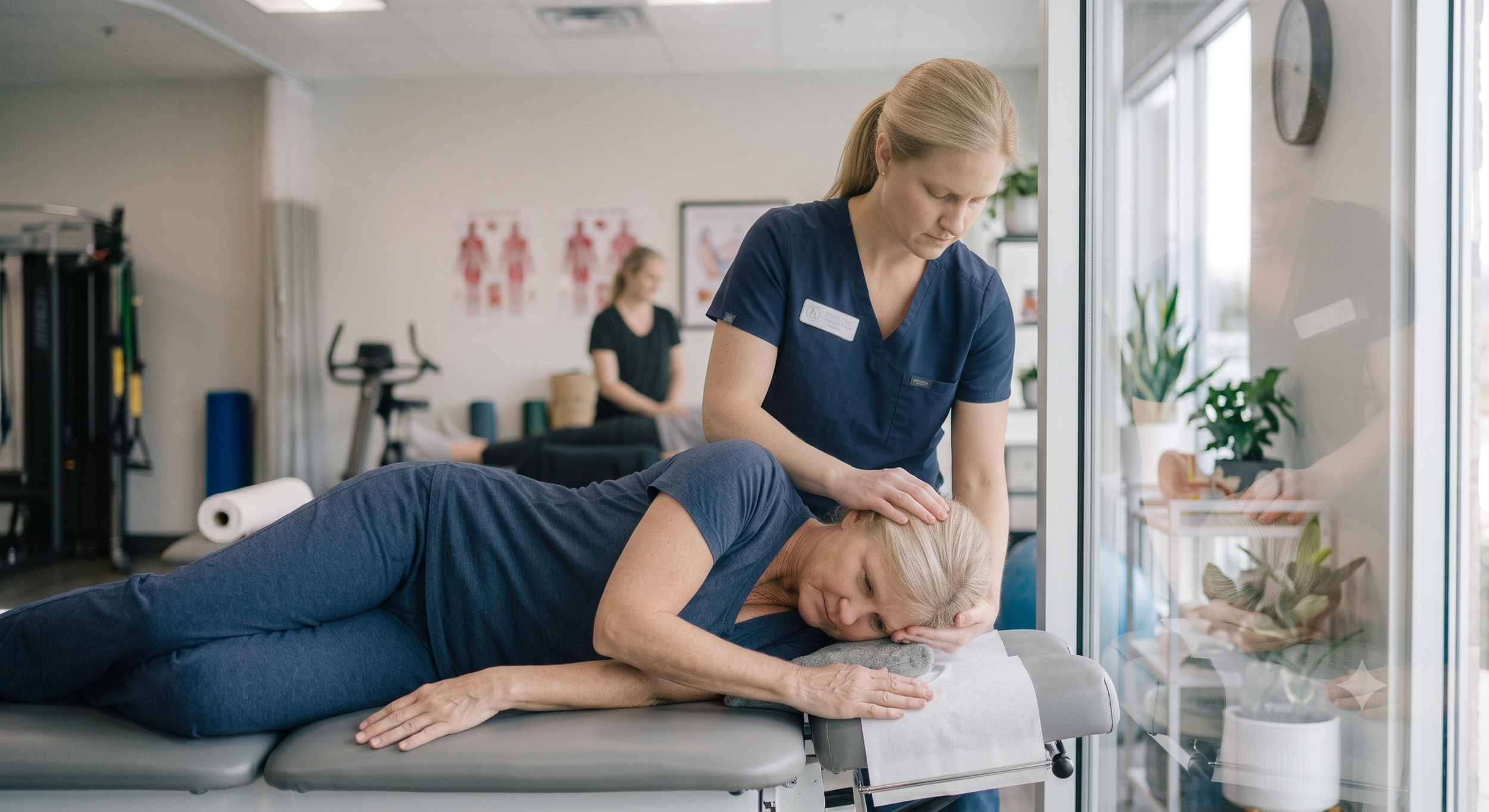
The Epley is a common treatment technique for many BPPV patients - but are there better options?
The conversation also got practical about maneuver selection. Brittany estimates roughly 85% of her BPPV cases are posterior canal (Epley territory), with the remaining 15%, or a bit more, falling into horizontal canal cases. For those, she reaches for the Gufoni maneuver almost exclusively, since it doesn't require flipping an anxious older adult prone through a full rotation like the barbecue roll does.
Both PTs also shared hard-won tips for keeping patients calm during the maneuver itself: explain what's coming before you start, have patients cross their arms over their chest instead of gripping the table (or your arm), and consider positioning yourself behind rather than in front of the patient. And despite what training videos suggest, the head doesn't need to be dropped fast. Speed only matters if the crystals aren't moving.
Red Flags: When It's Not a PT Problem
Not every dizzy patient belongs in a vestibular PT's schedule. Brittany and Kendra flagged several warning signs that point toward a medical rather than physical therapy issue, including the classic "5 Ds" (diplopia and other neurological symptoms), dizziness tied to eating (a possible blood sugar issue), and an abnormal ocular motor exam suggesting a central cause. Even something as simple as a recent switch to progressive or bifocal lenses can trigger dizziness that has nothing to do with the inner ear.
The Part After BPPV "Resolves"
One of the more clinically useful threads in the episode was about what Kendra calls "post-BPPV syndrome": the crystals are back in place, the Dix-Hallpike is clean, but the patient still doesn't feel right. Often it's fear rather than pathology. Patients avoid lying flat, sleep upright in a recliner, or refuse to move their head, which reinforces the exact avoidance pattern that keeps them symptomatic.
The fix looks a lot like chronic pain management: graded exposure back into the positions that provoke symptoms, education about what's actually happening, and encouragement to get back to normal activity, walking, sunlight, and elevated heart rate all help calm an overactive vestibular system back down. Recurrence rates for BPPV run as high as 50-60%, so Kendra and Brittany also make a habit of giving patients a home exercise "in their back pocket" in case symptoms return.
Why This Matters for Your Schedule, Too
Randall made a practical point that's easy to overlook: vestibular rehab is uniquely rewarding from a caseload perspective. Unlike a total knee replacement that keeps a patient on the schedule for 12-16 weeks, most posterior canal BPPV cases resolve in one to two visits. For clinicians drowning in follow-ups, building vestibular competence is one of the more efficient ways to free up slots while still delivering high-impact care.
Learn It Hands - On in Hawaii

Our courses in Hawaii! Where you can hit the beach after class!
Kendra and Brittany are bringing this exact approach, questions to ask, red flags to catch, and maneuvers to choose, to Jetset Physical Therapy's upcoming vestibular course on Oahu, September 26. As Brittany described it, the goal is to strip away the "fluff" that makes vestibular rehab feel intimidating: "It's either BPPV, it's either a hypofunction, or it's something else... it's very simple, right?"
If you've ever felt like you were guessing your way through a dizzy patient, or sending them down the hall to "the person who handles vestibular," this course is built to change that by Monday morning.
Jetset Physical Therapy also has courses coming up in Las Vegas (October 24-25) on Myofascial Decompression with Chris Deprato, held at Melville Winery. Follow along and join the email list for more 2027 course announcements.