
Walking Isn't the Whole Story: Why Acute Care OTs are important for the ADL Call
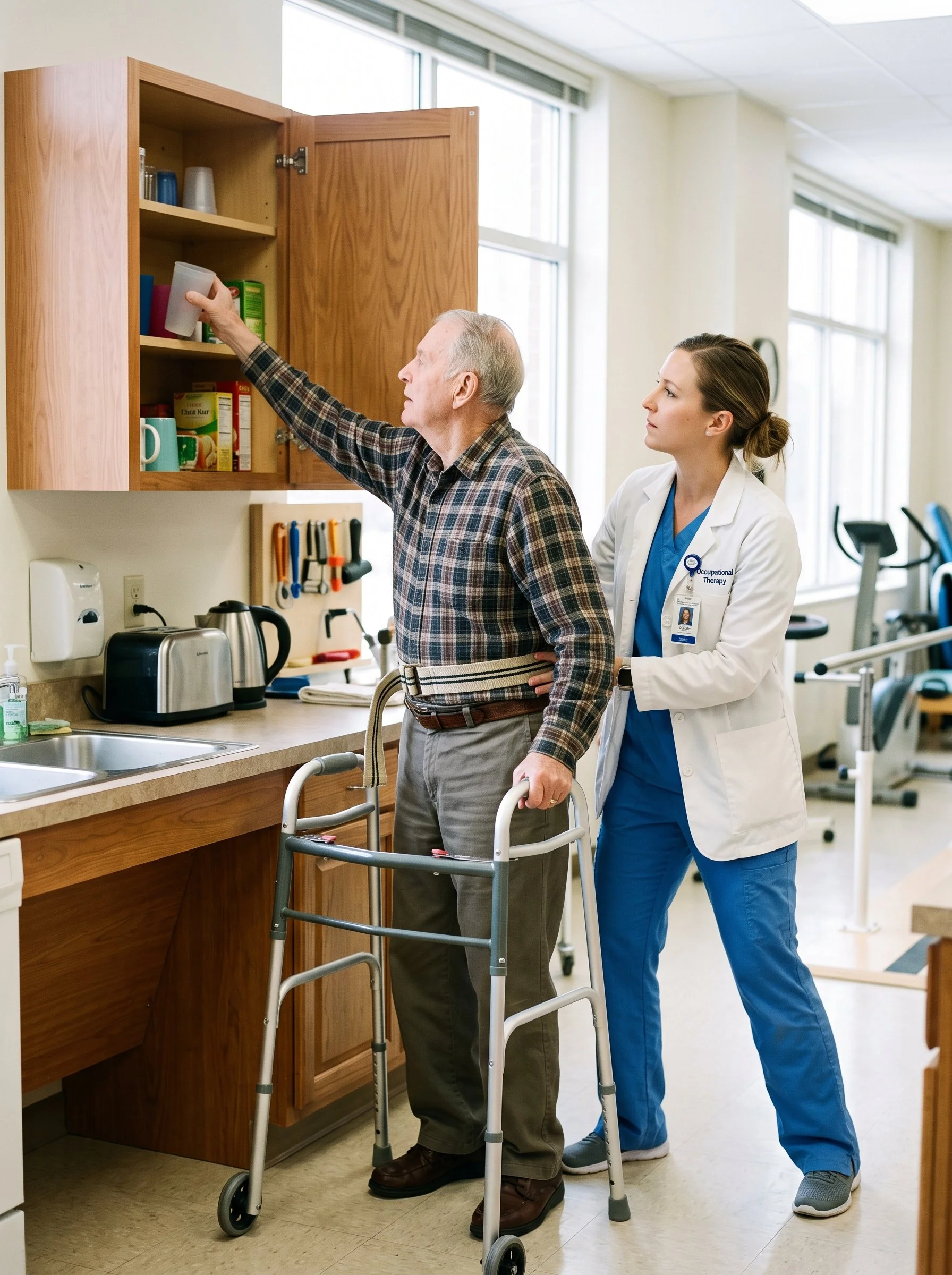
Your patient walked 200 feet. Can they shower, dress, manage their meds and stay safe at home? The evidence for why ADLs belong at the center of every discharge decision.
The PT note says "ambulated 200 feet, tolerated well." Case management reads that and starts planning a discharge home.
But nobody has watched this patient stand at a sink with their arms overhead, pull on socks after a hip replacement, sort a new medication list, or find the bathroom at 2am. Those are the moments that decide whether home is safe. That's OT's territory.
Yet many acute care OTs say the same thing: discharge planners skip their notes, and PT's recommendation carriesmore weight(.1) The research says that's a mistake. ADLs predict where patients go — and who comes back
In more than 17,000 admissions, the AM-PAC Daily Activity score predicted discharge destination at least as well as the
Basic Mobility score. Patients at or below a raw score of 19 were 11.4 times more likely to go to inpatient rehab and 8.9 times more likely to go to a skilled nursing facility. (2)
In another study of more than 26,000 discharges, low Daily Activity scores were linked to 30-day readmission. When both scores were analyzed together, only the ADL score stayed significant.(3) In other words, how a patient manages self-care told the team more about readmission risk than how they walked.
The stakes are high. Roughly 37% of older adults lose independence in at least one daily activity during a hospital stay.(4)
Four things an ADL session reveals that a hallway walk can't
1. Cognition in action. Can they follow a new medication schedule, sequence a shower, or remember their hip precautions? About 20% of acute care patients are readmitted within 30 days, and impaired cognition is frequently
implicated.(5) Functional cognition is OT's lane.
2. Delirium risk. Early OT and PT in ventilated ICU patients roughly halved delirium days in a landmark trial.(6) In a pilot trial of 140 older, non-ventilated ICU patients, adding twice-daily OT cut delirium from 20% to 3% and improved function and cognition at discharge.(7) A 2024 meta-analysis was more cautious about delirium itself, but found OT clearly improved ADLs and cognition.(8) The takeaway: OT belongs in the team's delirium approach. Yet one ICU chart review found only 8 of 100 OT notes addressed delirium.(9)
3. Physical demand walking doesn't test. Dressing runs about 2.8 METs and showering about 2.0 in healthy adults.(10)
Arm work has a lower ceiling than leg work,(11) and overhead tasks are harder to breathe through.(12) For patients with heart or lung disease, the shower can be the real stress test.
4. Safety with precautions. Hip, spine and sternal precautions change how every ADL is done. Some are evolving:
after heart surgery, "Keep Your Move in the Tube" got patients independent sooner without more complications.(13)
Strategies are discharge tools, not handouts
Equipment, setup, cueing and energy conservation don't just make tasks easier. They change what's safe.
A patient who can't shower standing but manages seated, with a handheld head and a planned rest, may be safe for home with home health. A patient who can't follow a pill organizer may need a caregiver plan before anything else. Those are clinical arguments, and they belong in rounds.
OT moves the numbers hospitals care about
Of 19 hospital spending categories studied across thousands of US hospitals, OT spending was associated with lower 30-day readmissions for heart failure, pneumonia and heart attack.(14) In stroke patients discharged home, five or more OT sessions were linked to far lower readmission odds.15 These are associations, not proof of cause, but they make the case that your sessions are a readmission strategy.
Own the call
Next time the team says "PT cleared them," answer with data:
"Mobility is good. ADLs are the limiter: they needed two rest breaks to shower and couldn't follow the new med schedule without cues. Home is reasonable with a seated shower setup, a pill organizer, and family supervision
for meds. Without that, I'd recommend more support."
That's not deferring. That's leading.
Grab the card
The Acute Care ADL Card gives you:
Side 1: the four things an ADL session reveals, the ADLs that show each one best, and the line for rounds
Side 2: the key research findings, with citations
